Bees provide a critical link in the maintenance of ecosystems, pollination. They play a major role in maintaining biodiversity, ensuring the survival of many plants, enhancing forest regeneration, providing sustainability and adaptation to climate change and improving the quality and quantity of agricultural production systems. In fact, close to 75 percent of the world’s crops that produce fruits and seeds for human consumption depend, at least in part, on pollinators for sustained production, yield and quality. Beekeeping, also called apiculture, refers to all activities concerned with the practical management of social bee species.
These guidelines aim to provide useful information and suggestions for a sustainable management of bees around the world, which can then be applied to project development and implementation.
Read more here
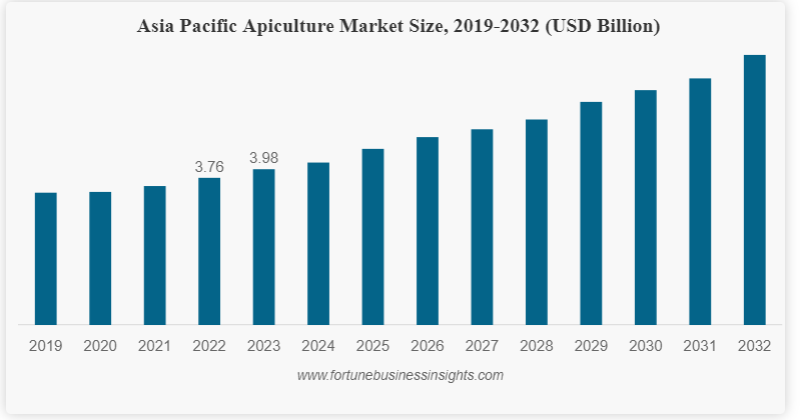
The apiculture market size was valued at USD 11.15 billion in 2023 and is projected to grow from USD 11.75 billion in 2024 to USD 18.59 billion by 2032, exhibiting a CAGR of 5.90% during the forecast period. Asia Pacific dominated the apiculture market with a market share of 35.7% in 2023.
Apiculture, also known as beekeeping, refers to the practice of nurturing and culturing honeybees by using numerous commercial and scientific methods. This farming process involves the cultivation of the genus Apis honeybees to produce a diversified range of bee products, such as honey, bee pollen, and beeswax, among others. Factors such as the growing demand for beekeeping products due to the surging health-conscious trend and rising governmental support are pivotal reasons for the market’s growth. Currently, apiculture is crucial in several industries, including the food and pharmaceutical sectors. In the food processing industry, honey has emerged as one of the most suitable and preferred products in preparing a wide variety of food items. On the other hand, in the pharmaceutical industry, honey and royal jelly are widely used to manufacture dietary supplements or are often accompanied as a supplement with other products.
Due to the well-known properties of bee products (honey, royal jelly), the market experienced impressive growth during the pandemic period. The majority of the population believed that consuming apiculture by-products would help improve the immune system, which, in turn, fueled the sales of such products. According to the ‘United States Department of Agriculture,’ – a government agency stated that the U.S. consumption of honey grew by 8% in the year 2021 compared to 2020. This growth in demand was majorly responsible for the consumer’s association with honey as a superfood, as well as the rising perception of honey as a natural and healthy sweetener.
Source: link
Bees are one of the many insects in the world that can produce something that is beneficial to all of us. We obtain honey from these bees and as we all know, honey is an important food for human beings. Since ancient times, honey is used for treating several diseases, and it is an antioxidant, therefore beekeeping is an important activity.
“Apiculture is the scientific method of rearing honeybees. “
The word ‘apiculture’ comes from the Latin word ‘apis’ meaning bee. So, apiculture or beekeeping is the care and management of honey bees for the production of honey and wax. In this method, bees are bred commercially in apiaries, an area where a lot of beehives can be placed. Usually, apiaries are set up in areas where there are sufficient bee pastures – such as areas that have flowering plants.
Bees are mainly reared for their honey. Besides that, we also obtain beeswax through beekeeping. Bees produce honey from the sugary secretions of plants. Although honey is an important ingredient in many food dishes, beeswax holds a lot of commercial significance too. It is used in the cosmetic and medical industry, as well as a coating for cheese, and as a food additive. It is also used as the main component for making candles, preparing polishes for the shoe, furniture, etc.
Read more here